Create a writing space of your own
by Beth Mende Conny © 2000-2026
When we talk about creating a writing space, we're really talking about two kinds: a physical space and a mental space. You need both in which to work.
Sure it would be great to have a fantastic office with a great view, but if you can't keep others out of it or get yourself into it, it won't do you much good.
Let's start then with mental space. You lay claim to it through declaration: "I am a writer."
Sounds simple, but it's not, for you have to speak with conviction. If you don't, you won't take yourself seriously, and neither will others. They'll keep crossing the boundaries you've never set.
To write, you must let others know where you begin and end, how you need a place to call your own, be it a room, corner or desk. They may not like what they hear, but most will grudgingly acquiesce with time.
Next up, physical space.
As much as you would like, you don't need a room of your own. For example, when I first launched my writing career, I shared my first "office" with a washer and dryer. It was in what had once been a storage room and when it rained it flooded, which meant I couldn’t hang out in there because I would have gotten electrocuted.
My second office was a corner of my dining room; my third, was my daughter’s bedroom. This was when she was very young.
None of these were ideal; nonetheless, within each I wrote scores of articles and books, amid dirty laundry, place settings and baby toys.
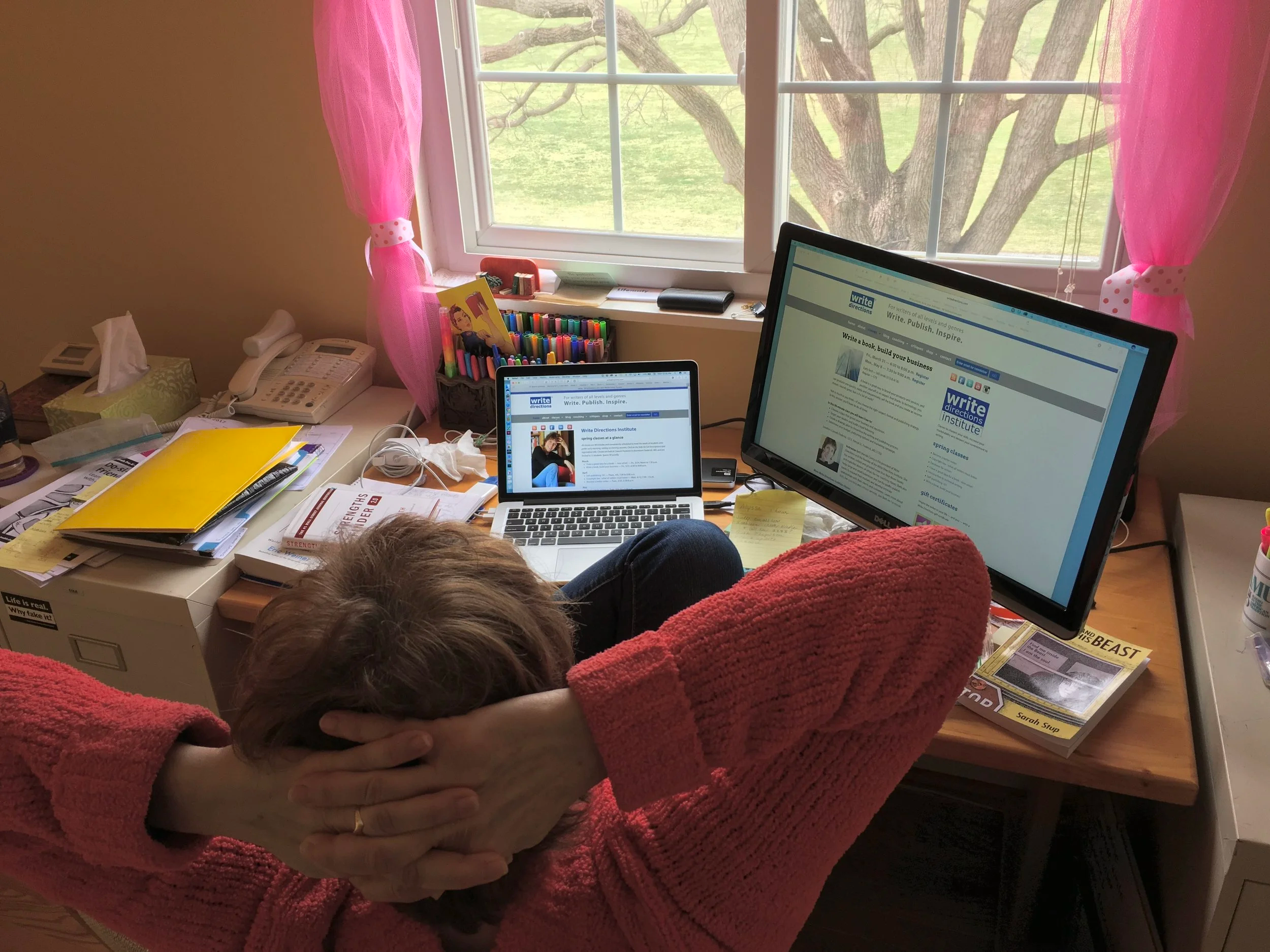
Today, I have a great office with two windows and a door that locks. I've earned it. But it's only one my work spaces. I also have my favorite tables at local coffee shops, even though I don’t drink coffee because I hate the taste. When I visit coffee shops, I bring my laptop, some pens and pads and reference books if I need any. I obviously try to pick a place that has WiFi, though I don’t necessarily use it because I run the risk of checking emails and newspapers; once I’m sucked into the Web’s black hole, I likely won’t get out.
One of my most productive spaces is my bed. I’ve written some of my absolute best work at 2 a.m., propped up on pillows, a flashlight crooked in my neck. I’ve also done some pretty darn good work in the shower. See, it’s important to remember that you don’t have to write to be writing. Sometimes the best thing you can do is simply think.
Let me wrap up here with a few remarks about interruptions.
As I’ve mentioned, you’ve got to lay claim to your space, and space is both mental and physical. You might be good at this; nonetheless, you won’t be able to prevent interruptions. My family still interrupts me. I still get emails and phone calls I have to answer. People come to my door trying to sell me all sorts of things. These are all hard to deal with, but that’s okay. See, interruptions are okay if they happen just once in a while.
Interruptions are the crack through which everyday life slips, the very life that allows me to transform thoughts, experiences and emotions into words. These words also form a space for my creativity.
Know then that you need — and can have — any number of places in which to work. Look around, look within, then write. The very act of writing creates its own space.
Feel free to share or post this piece. Please include the following: Beth Mende Conny © 2000-2026